

Showing posts with label Revolution. Show all posts
Showing posts with label Revolution. Show all posts
Saturday, February 19, 2011

Sunday, February 13, 2011
Altaf asks people to brace for revolution

Altaf Hussain said if US decided to release Dr Aafia,we would try to convince families of people to accept blood money n forgive Davis
Muttahida Qaumi Movement chief Altaf Hussain has said a revolution of patriotic Pakistanis on the pattern of the French Revolution is knocking on the door of the country, and asked “patriotic army generals” to get ready to save the sovereignty of Pakistan.
He has further said that if the US agrees to release Dr Aafia Siddiqui, the heirs of the two young men shot dead by American national Raymond Davis could be requested to pardon him.
Hussain was delivering a telephonic address to a huge audience gathered to welcome former Test cricketer Sarfraz Nawaz at ë90’ in Azizabad on Friday.
Nawaz was accorded a rousing welcome as he was received by MQM Rabita Committee members headed by Deputy Convener Dr Farooq Sattar. The party workers were chanting “Altaf, Altaf” slogans and waving MQM flags.
On the occasion, Hussain asked Nawaz to work with dedication and, as like his impressive bowling, he was supposed to bring the wealth looted by the corrupt elements back to the country.
The MQM chief advised the former Test cricketer to work like any other MQM worker and shed his ego since he had now joined the Muttahida.
Nawaz responded by saying that he would serve the MQM just like an ordinary worker under his (Hussain’s) leadership.
The MQM leader once again said that the corrupt people should not be allowed to escape and they should be hanged publicly. He said that the people should now understand that the time had come to eliminate corruption from Pakistan and for this a revolution had been knocking on the door of the country.
He once again reiterated that all those corrupt army generals who led the country’s disintegration and gave powers to feudal lords should be hanged publicly, adding that all those generals who caused the country’s disintegration would have to face a situation similar to that in Egypt.
He said that the majority of army generals had become a liability on Pakistan and a burden on the people.
“Our army generals had joined hands with feudal lords, entrepreneurs and elements involved in looting the national exchequer and forged a relationship with these corrupt people, thus constituting one family,” he said, adding that the country had been facing the worst economic crisis and all the people needed to join hands to steer Pakistan out of the present morass.
”Karachi is an economic hub of the country; therefore, peace has to be restored in this city at all costs,” Hussain said and appealed to all the political and religious parties to join the MQM before it was too late to save this country.
He said that the wealthy class had been enjoying all kinds of privileges and was considered as above the law, but if a revolution of middle and poor segments of people came, then those who had looted the country would be held accountable without any discrimination.
Hussain said that negative propaganda was being launched against the MQM only because it raised the voice for the poor and middle class people as well as for getting rid of the inherited political culture of feudal lords.
He said that despite negative propaganda against the party, the MQM had been continuing Jihad against the two percent privileged class of the country.
Referring to the under-trial US citizen, Raymond Davis, the MQM founder said that the US should wait for the court decision and stop putting pressure on Pakistan in this regard.
However, he added that if the US handed over Dr Aafia Siddiqi to Pakistan, his party could request the heirs of the two men killed by Raymond Davis to forgive the US citizen and accept compensation in return.Former test cricketer Sarfaraz Nawaz said the country will one day see a prime minister from the the Muttahida Qaumi Movement.
The former test cricketer, who has recently joined the MQM, said he needed a party which was against corruption, saying he had been attacked in the Punjab Assembly for having raised his voice against corruption.
He said the MQM would now enter the Punjab with a new spirit which would subsequently spread all over the country.
Dr Farooq Sattar said on the occasion that the MQM was emerging as a third option in the politics of the country.
Sarfaraz said he was moved by the love and affection he received during his visit to Nine-Zero on Friday.
He said he had been observing the performance of the MQM for the last four years, raising its voice for the poor and the middle classes and this made him join the party.
Sarfaraz said that the feudal lords had plundered the country, and to get rid of such corrupt elements, the people should come under the flag of the MQM.
He said his leader, Altaf Hussain, wanted a Pakistan that was free from corruption where the people were genuinely empowered.
Saturday, February 12, 2011
New dawn for Egypt as Mubarak toppled
 GEO
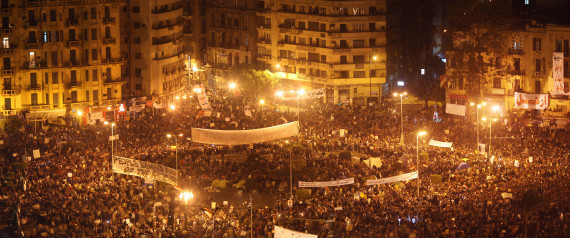
CAIRO: Thousands of Egyptians were still singing and waving flags as dawn broke over a nation reborn on Saturday, after a popular uprising forced president Hosni Mubarak from power.
The streets and squares of downtown Cairo were still in the hands of the mostly young demonstrators whose determined 18-day revolt overturned 30 years of autocratic rule and triggered an outpouring of national solidarity.
But political power now rests with the military commanders who stepped into the vacuum left by Mubarak's departure, and many people were anxiously waiting to see whether they will make good their promise to respect the popular will.
In Tahrir Square, the epicentre of the revolt, many of the anti-regime protesters who had occupied the city's vast central plaza since January 28 were still sleeping in makeshift shelters, now joined by exhausted wellwishers.
"It's party time! We are born again," declared 40-year-old agricultural engineer Osama Saadallah. "We were behind other countries, now we are worth something in the eyes of others, of the Arab world."
The army began moving tanks to the sides of roads leading into the central square and dragging away the metal barriers, barbed wire and burned wrecks of cars that had served as a cordon during the revolt.
The Cairo press, including state-run titles that had initially dismissed the uprising or charged that it was being fomented by foreigners, hailed the "Revolution of the Youth."
But if Egypt's revolution is indeed to serve as an example to the region, as Tunisia's revolt inspired Egypt, much will depend on the stance of the junta that stepped into the breach when Mubarak's nerve broke.
Headed by a longtime Mubarak loyalist, 75-year-old Field Marshal Mohammed Hussein Tantawi, the Supreme Council of the Armed Forces was expected to make a statement about its plans to form a transitional government.
So far, it has given little clue as to the direction it will take. In its "Statement Number Three" since announcing that it was taking charge, it said simply that it would respect the mood of the newly energised street.
The council "will issue further statements that will announce forthcoming steps, measures and arrangements, and it affirms at the same time that it is not a replacement for the legitimacy that is acceptable to the people."
If the generals go back on their word, the protests could start again.
"We're waiting for a new statement from the army," said Mohammed Rida, a 26-year-old activist. "We don't want to be ruled by the military. We want a coalition government with experienced figures."
In the euphoric atmosphere -- all night Egyptians had drummed, sang and danced, firing jets of flame from aerosol bottles -- it was hard to believe the news had broken just hours earlier.
A grim-faced Vice President Omar Suleiman announced the handover on state television late Friday after more than a million furious marchers took to the streets of Cairo, Alexandria, Suez, Port Said and beyond.
Wednesday, February 9, 2011
PIA employee strike enters second day

KARACHI: A strike by Pakistan International Airlines (PIA) employees across the country entered its second day – forcing the airline to cancel several flights – and affecting more than a thousand passengers, on Wednesday.
Staff demand the scrapping of a proposed codesharing agreement with Turkish Airlines that would see PIA relinquish most of its routes to Europe and the United States, and the sacking of managing director Aijaz Haroon.
Company and aviation officials said at least 30 flights had been cancelled since the strike began, including flights to Britain, the Middle East, Europe and Asia.
Prime Minister Yousaf Raza Gilani delegated his defence minister to resolve the strike “urgently”, calling for a negotiated agreement between staff and management “in the larger interest” of the national carrier, his office said.
Five pilots were recently suspended and around 70 PIA employees forced into compulsory leave last month for “agitation” against management plans, a senior company official told AFP on condition of anonymity.
The proposed codeshare, which still needs to be approved by the government and regulators, would mean PIA relinquishing lucrative routes to Germany, Italy, the Netherlands, Spain and US destinations New York and Chicago.
PIA last year asked the government, already saddled with mounting debt and struggling to contain the fallout from catastrophic flooding, to write off losses of $1.7 billion to save it from looming bankruptcy.
Airline spokesman Mashhood Tajwar played down the fallout, saying the situation at Islamabad airport, where a backlog of planes unable to take off was building up, had “started to improve”.
He said about 5,000 passengers had been affected by cancelled flights.
PIA managing director Haroon, who is considered close to President Asif Ali Zardari, told AFP that management was working to restore flight operations as soon as possible.
But Sohail Baloch, president the Pakistan Airlines Pilots Association, said neither the management nor the government had invited it for talks.
“Our agitation will continue until the management declares its agreement with Turkish Airlines null and void, and that all employees who have been suspended are reinstated.”
Dozens of PIA staff blocked a road outside Islamabad airport, causing traffic mayhem and shouting “even a dog would be insulted to be called MD (managing director) PIA” and denouncing the Turkish proposals.
Passengers who turned up at the airport, were left standing around complaining about the disruption.
“I’ve been waiting here for the last four hours. PIA people say the flight is ok, but the security people aren’t allowing us to proceed to check-in,” Gulfraz Majeed, a 52-year-old en route to the north of England, told AFP.
“Once I reach Britain, I’m going to sue PIA and demand compensation. They’re bound to give us a hotel and alternate flight, but they haven’t bothered to offer us a single cup of tea,” Majeed said.
National airlines can’t negotiate with foreign countries without approval
A spokesman for the Ministry of Defence today said that national airlines cannot negotiate with foreign countries without prior approval.
He said the Ministry of Defence was evaluating the Record of Discussion which was signed between PIA and Turkish Airlines to determine its implications.
The Ministry would be in a position to determine the appropriate course of action after its evaluation, he said.
He also clarified that the Record of Discussion could not be termed a Memorandum of Understanding (MoU).
The spokesman said that the tussle between the PIA management and its employees was due to differences over the financial and commercial aspects of the Record of Discussion.
NA committee slams PIA, Defence Minister
Defence Secretary Syed Athar Ali and Aijaz Haroon appeared before the National Assembly’s Standing Committee on Defence today, Express 24/7 reported.
Haroon admitted to the committee that it was a mistake to not inform the Defence Ministry in writing about talks with Turkish Airlines but he said that no law had been violated in holding talks.
Meanwhile, the Defence Secretary Ali differed with the views of Haroon, saying that PIA’s negotiations with the foreign airline were against the law.
A member of the committee, Sardar Mehtab Abbasi, has demanded a criminal probe into the crisis.
Similar views were expressed by another member, Sardar Haider Ali Shah, who said that the Defence Minister and the managing director of PIA should be handed over to the National Accountability Bureau (NAB) for a probe.
Show-cause notices suspended
The Sindh High Court (SHC) suspended show-cause notices issued to the PALPA president and secretary.
The Defence Ministry had served show-cause notices to two PALPA leaders, Sohail Baloch and TM Rabbani, for instigating the employees to strike.
Baloch and Rabbani’s lawyer filed a petition in SHC – stating that his clients have challenged the compulsory service act for PIA pilots. He said the show-cause notices were issued to pressurise his clients.
Suspending the notices, the court has summoned PIA and the Defence Ministry officials on February 17.
Sunday, February 6, 2011
Egypt ruling party leaders resign, protesters unmoved

* Mubarak’s son Gamal resigns, Hossam Badrawi named new secretary general * Muslim Brotherhood says no Islamic revolution in Egypt * Saboteurs attack gas pipeline to Jordan
CAIRO: The leadership of Egypt’s ruling party quit on Saturday, but the protesters who have rocked the political establishment dismissed the move as a ruse that would not deter them from their goal of toppling the president.
Reports by Al Arabiya saying President Hosni Mubarak had resigned as head of the party were later withdrawn by the Dubai-based television news channel.
State television said only the leadership of the party, including Mubarak’s son Gamal, had resigned and named the new secretary general as Hossam Badrawi, seen as more liberal. But the protesters were not impressed by the latest gesture. “These are not gains for the protesters, this is a trick by the regime. This is not fulfilling our demands. These are red herrings,” said Bilal Fathi, 22.
Earlier, Mubarak met some of the new ministers, the state news agency said, in a clear rebuff to the hundreds of thousands of anti-government protesters.
Meanwhile, Egypt’s influential Muslim Brotherhood is keeping a low profile in the current unrest because it does not want the revolt to be seen as an Islamic revolution, one of its leaders said.
“It is an uprising of the Egyptian people,” spokesman Rashad al-Bayoumi told the German weekly Der Spiegel, while accusing Mubarak’s government of distorting the image of the movement.
“The West won’t listen to us, but we’re not devils. We want peace not violence,” he said. Separately, unknown saboteurs attacked an Egyptian pipeline supplying gas to Jordan, forcing authorities to switch off gas supply from a twin pipeline to Israel, an official told AFP.
The attackers used explosives against the pipeline in the town of Lihfen in northern Sinai, near the Gaza Strip, the official said. It was initially thought the pipeline to Israel was attacked.
Thursday, February 3, 2011
Egypt's Facebook Use Skyrockets Following Internet's Return
Use of Facebook by users from Egypt has surged following the restoration of Internet service to the country.
Egypt was plunged into an Internet blackout last week after ISPs caved to government demands and shut off access to the web. The crackdown lasted several days, though service was restored on Wednesday, the same day that the block on social networking sites Facebook and Twitter was lifted.
Facebook has seen activity on its site increase dramatically since the country went back online.
"Since access was restored, we have more users than ever," Facebook spokesperson Andrew Noyes told The Huffington Post in an email.
Facebook has around 5 million users in Egypt, a fifth of which are mobile users.
Noyes observed that the number of Groups and Pages created by users from Egypt have "risen sharply": in the past two weeks, around 32,000 groups and 14,000 pages have been created. The most popular Facebook Page among users from Egypt belongs to Amr Khaled, a preacher who has over 2 million "likes," followed by that of an Egyptian radio host, Amr Diab.
Prior to the Internet shutdown, Egyptians had turned to Facebook, among other sites, to organize protests.
Saturday, January 29, 2011
Battlefield Egypt

* Army called in, curfew imposed across country
* 5 killed, 870 injured as protesters clash with police
* Several govt buildings, vehicles torched
* Opp demands interim govt
CAIRO: Tens of thousands of protesters filled the streets of Egypt on Friday, prompting Egyptian President Hosni Mubarak to impose a curfew to cover all 28 governorates in the country, state television announced at the end of a fourth day of mass nationwide protests.
He had earlier declared a curfew in Cairo, Alexandria and Suez.
“Following the earlier decree... the commander of the armed forces has decided to extend the curfew to cover all governorates in the country,” state television said.
The curfew was to run from 6pm to 7am until further notice.
The president “has asked the armed forces, in cooperation with the police, to implement the decision, and maintain security and secure public establishments and private property,” it said.
In Cairo, protesters poured out of mosques after Friday prayers and ran rampant through the streets, throwing stones and torching two police stations as police chased them with batons, firing tear gas, water cannons and rubber bullets.
In the canal city of Suez, protesters overran a police station, seized weapons and set fire to security force vehicles in fierce clashes in which a demonstrator was killed, witnesses said.
The nationwide demonstrations, inspired by the “Jasmine Revolution” in Tunisia, have swelled into the largest uprising in three decades, sending shockwaves across the region. Eight people have been killed, hundreds injured and some 1,000 arrested.
But in a hint that authorities might heed the rising tide of popular anger, a senior lawmaker and member of the ruling party called for “unprecedented reforms” in order to stave off a revolution.
Egypt is one of Washington’s closest allies in the region, but analysts say the United States is growing increasingly concerned that its refusal to implement more political reforms could lead to further unrest and instability.
That was reflected on Friday when Fitch ratings agency said it had revised its ratings outlook for Egypt to negative.
Demonstrations spread around the capital of Cairo, where police appeared overwhelmed as protesters broke through several police barriers.
Protesters were seen being dragged away and pushed into police vans, as others defied the heavy police presence and made their way to the central Tahrir Square.
Leading dissident Mohamed ElBaradei, who has said he would be prepared to lead a transitional authority if he were asked, was among a crowd of around 2,000 targeted by police and was forced to take refuge inside a mosque in Giza Square and not allowed to lead.
The crowd attacked police vans, torching one, after a civilian had most of his hand blown away, allegedly by police.
Protesters also set fire to the governorate building in the centre of Alexandria.
Medical sources said at least five protesters killed and 870 were wounded on a day that saw security forces using rubber bullets, tear gas and water cannon to disperse crowds. Some were in a serious condition with bullet wounds.
The main opposition party, Wafd, said Egypt needs a period of transitional rule, new parliamentary elections and amendments to the constitution so a president can stand for only two six-year terms. agencies
Subscribe to:
Posts (Atom)